 Trusted Contractor Since

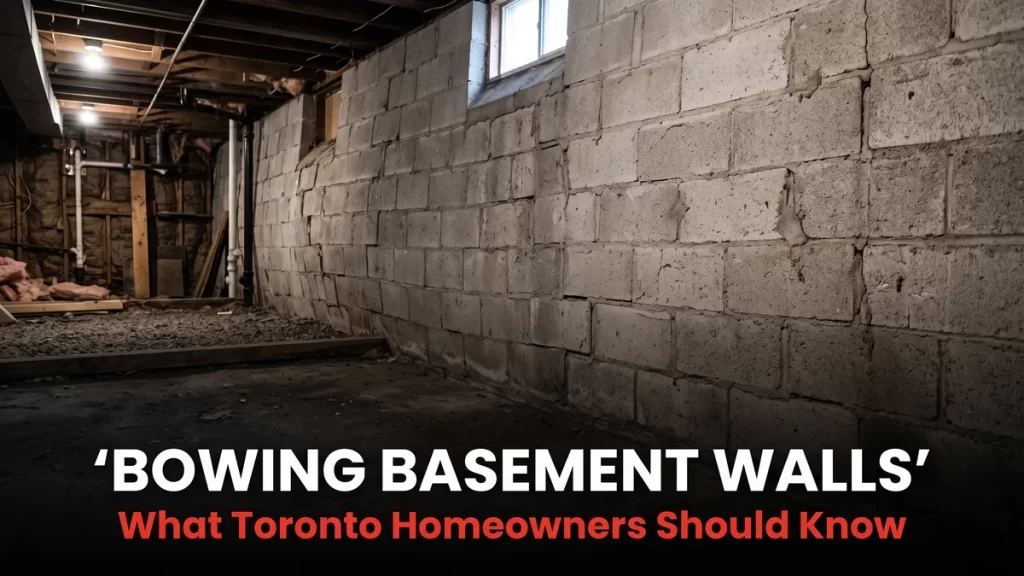
You went down to grab something from storage and noticed the wall looked different. A long crack runs sideways across the concrete block, roughly at waist height. When you set a straight level against it, the wall is clearly leaning inward. That is exactly what bowing basement walls look like. If you caught it now, you are in a much better spot than the homeowner who ignored it for three harsh winters. Our foundation waterproofing team in Toronto sees this structural issue every spring.
A bowing wall is not the same as a simple, cosmetic hairline crack. It means the soil outside is physically winning the battle, and the foundation wall is slowly giving way. Here is exactly how to read a bowing wall, what structurally causes it, and what actually fixes it for good.
In This Article
What a Bowing Wall Actually Means
A basement wall is structurally designed to hold back the heavy soil surrounding your foundation. That soil is always pushing sideways, and a healthy wall easily shrugs that pressure off. Bowing means the sideways pressure has finally grown past what the wall can carry. Because of this, the middle of the wall starts curving inward while the top and bottom remain firmly pinned in place.
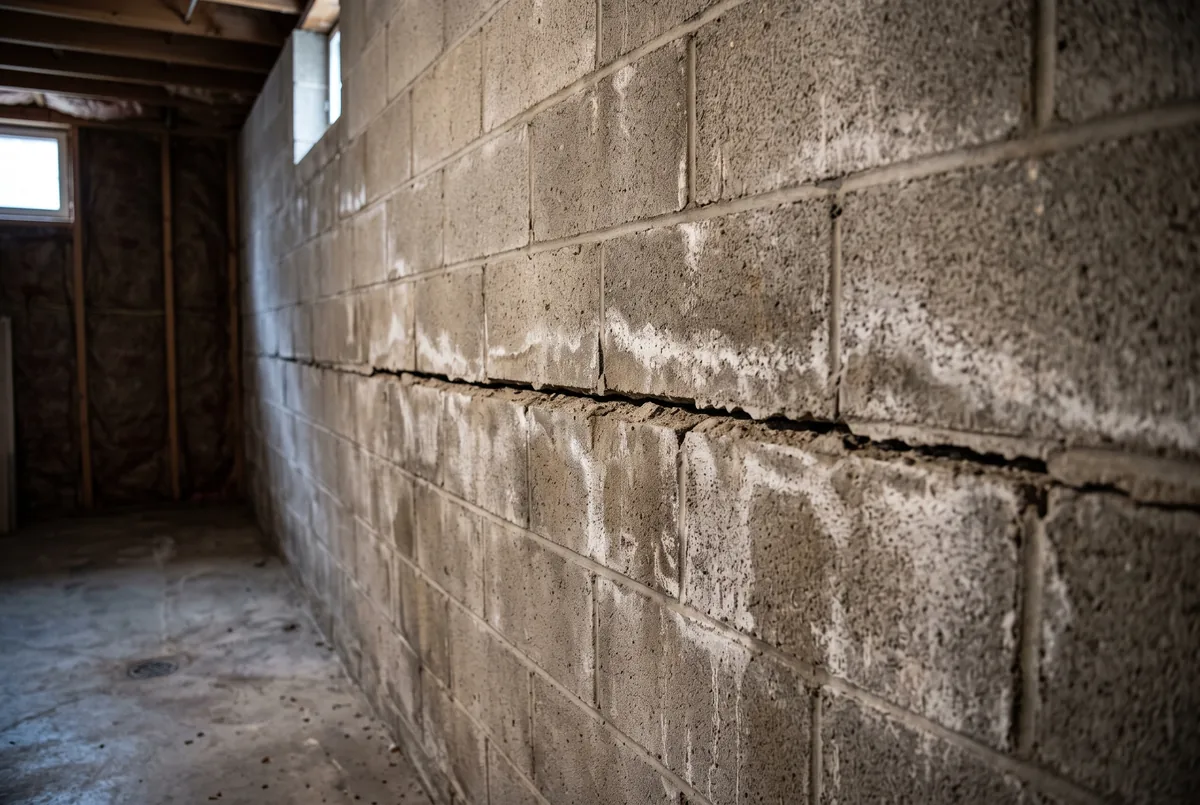
You usually see it first as a horizontal crack partway up the wall, because that is exactly where the bending stress peaks. In a concrete block wall, the crack often follows a horizontal mortar joint straight across. The wall is not just cracked; it is actively deflecting. That deflection tends to grow with every single wet season until something intervenes to stop it.
Did You Know?
Structural engineers often flag a block wall for immediate repair once it bows past roughly 2 inches of horizontal deflection. Past that specific point, the wall has lost a massive share of its load-bearing capacity and can fail very quickly. Under 2 inches, the fixes are much simpler and far less invasive, which is exactly why catching it early matters.
Why Toronto Soil Pushes Walls Inward
Toronto and the surrounding GTA sit on a very high amount of clay. Clay soil actively holds water. When it takes on water, it swells significantly, and when it dries out, it shrinks. That constant expansion and contraction cycle drives a huge amount of the lateral pressure that aggressively bows foundation walls right across the city.
Add the harsh freeze-and-thaw pattern of a typical Toronto winter and the pressure gets noticeably worse. Wet clay resting against the foundation freezes, expands, and physically shoves the wall inward. Then it thaws and the exact cycle repeats. Do that for enough winters against a wall that already had incredibly poor exterior drainage, and the wall inevitably starts to move.
- Expansive Clay Soil: This soil forcefully swells with every single wet spell.
- Frost Pressure: This occurs from water freezing in the soil resting directly against the wall.
- Poor Exterior Drainage: This keeps the soil completely saturated, which is exactly where professional exterior waterproofing in Toronto comes in.
- Heavy Surface Loads: Driving or placing heavy loads like a driveway, heavy patio, or vehicle parked too close to the foundation adds lateral stress.
- Poorly Compacted Backfill: Backfill that was never compacted properly when the home was originally built allows water to gather and expand.
People Often Ask: Is a Bowing Wall an Emergency?
It depends heavily on how far it has actually moved and whether it is still actively moving. A very slight bow accompanied by a hairline horizontal crack is a “call-a-pro-soon” situation. A wall bowed more than 2 inches, actively cracking, with blocks shifting out of line, is much closer to an urgent structural emergency. When in doubt, get it evaluated by an expert before the next big freeze or spring thaw adds even more pressure.
Warning Signs to Check This Weekend
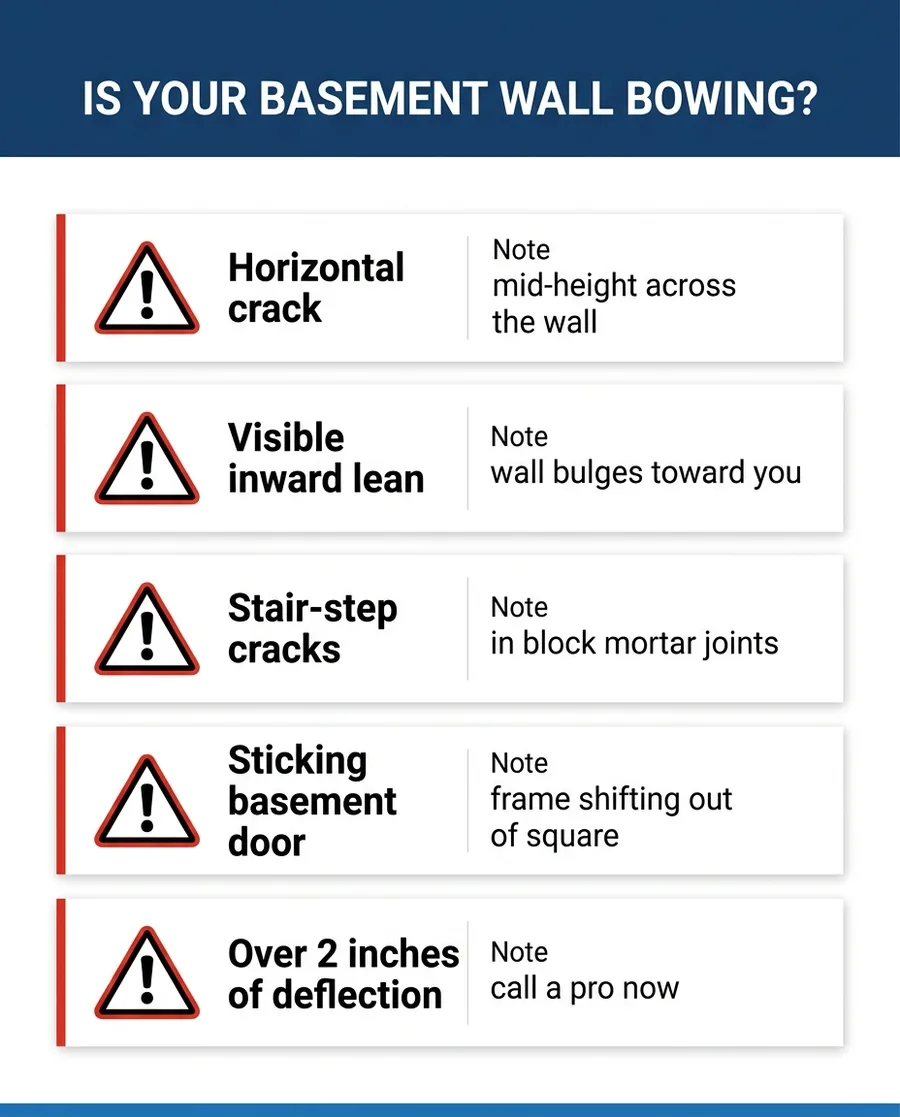
You do not need specialized tools to spot the early stages of a failing foundation. Take a bright flashlight and a straight level down to your basement and look for these warning signs.
- A Horizontal Crack Across the Wall: Usually found at mid-height, often tracing along a block mortar joint. This is the classic bowing signature.
- A Visible Inward Lean: Hold a level or a perfectly straight board vertically against the wall. A gap in the middle absolutely means the wall is curving inward.
- Stair-Step Cracks: Look for cracks climbing diagonally through the mortar joints near the foundation corners.
- Doors or Windows Sticking: Watch for frames shifting out of square on the upper floors.
- White Efflorescence or Damp Patches: These chalky marks sit along the crack, serving as a clear sign that water is finding its way right through the foundation.
Pro Tip
Mark the exact end of the crack on the wall with a pencil and write the date right beside it. Check it again in a month. If the crack has grown past your pencil mark, the wall is actively moving and needs professional attention sooner rather than later. A crack that has not physically moved in over a year is far less urgent.
How Bowing Basement Walls Get Fixed
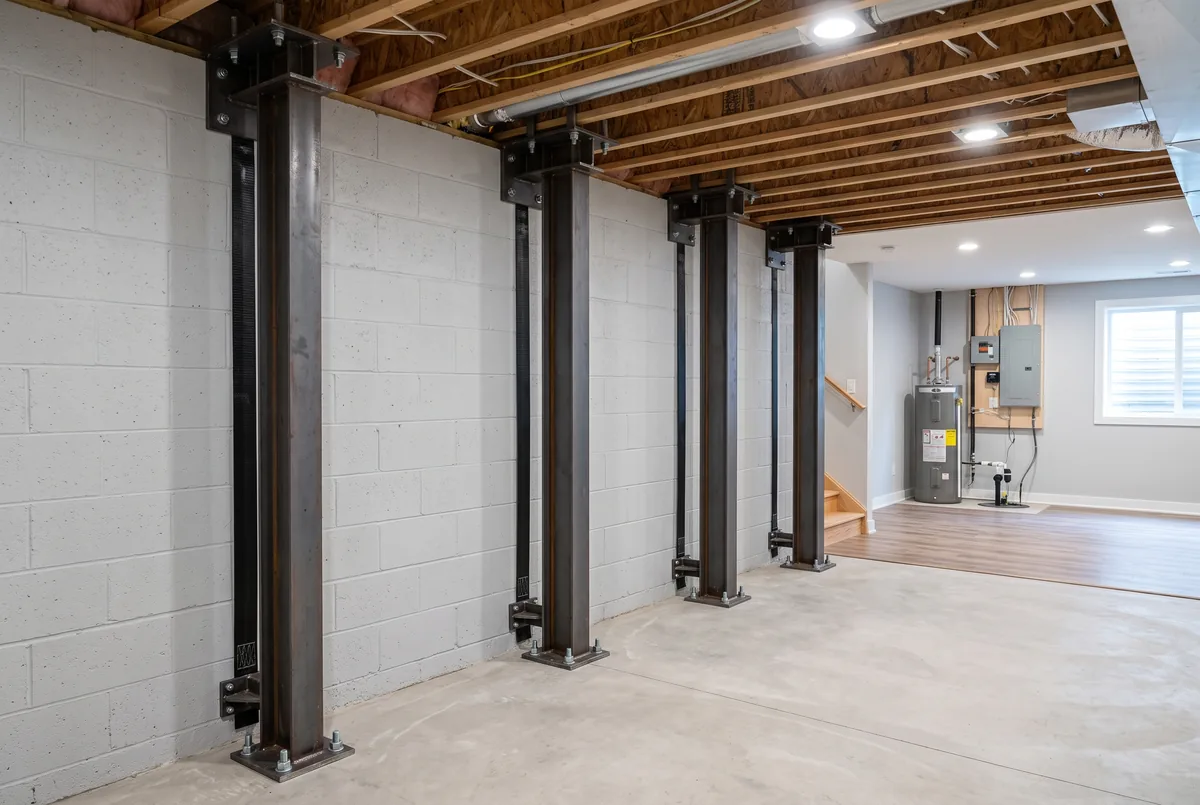
There is no single universal fix, because the right approach depends entirely on how far the wall has moved and whether it is still actively moving. Here are the three main approaches and exactly where each one fits.
| Repair Factor | Carbon Fiber Straps | Steel I-Beams | Full Wall Rebuild |
|---|---|---|---|
| Best For | Early bowing under 2 inches | Moderate bowing and active movement | Severe structural failure and crumbling block |
| Disruption Level | Low, completed interior only | Moderate, completed interior | High, often needs deep exterior excavation |
| Stops Further Movement? | Yes, safely holds the current position | Yes, can slowly straighten the wall over time | Yes, entirely replaces the broken wall |
| Addresses the Water Cause? | Only with additional drainage work | Only with additional drainage work | Usually strictly paired with exterior waterproofing |
The key takeaway is very clear. Bracing the wall and fixing the root water problem are two completely different jobs. Carbon fiber straps or heavy steel hold the wall up, but if saturated clay keeps pushing from the outside, you have only bought yourself a little time. Real, permanent repairs almost always pair the structural work with better foundation drainage, which is exactly why exterior waterproofing so often comes up in the exact same conversation.
Please note: Structural foundation repair in Ontario should always be expertly designed and formally inspected to the rigid standards set out in the Ontario Building Code. This article provides general information, not a formal structural assessment. A heavily bowing wall can fail suddenly. Have it thoroughly evaluated by a qualified foundation contractor or structural engineer before deciding on a repair.
How to Keep It From Happening Again
Whether you have already had a foundation wall repaired or you simply want to keep a healthy wall safe, the long-term goal is exactly the same. You must keep water away from the foundation so the exterior clay never gets a chance to swell and push.
- Grade the Soil to Slope Away: Ensure the ground slopes away from the house, targeting at least a few centimetres of drop per metre for the first two metres.
- Disconnect and Extend Downspouts: Make sure roof water lands well away from the foundation wall.
- Keep the Exterior Drainage Working: For many older Toronto homes, this absolutely means installing a functioning weeping tile and, in tougher cases, investing in full exterior waterproofing.
- Watch Heavy Loads Near the Wall: Do not excessively pile soil, park heavy vehicles, or build a heavy patio hard against the foundation without fully accounting for the added pressure.
- Re-Check the Wall Every Spring: The messy freeze-thaw season is exactly when new structural movement typically shows up.
Save Your Money
Fixing poor exterior drainage before the wall physically moves is a mere fraction of the cost of straightening or rebuilding a wall after it fails entirely. The Toronto homeowners who spend the absolute least on foundation repairs are the ones who proactively kept water away from the wall in the first place. Basic landscaping grading and downspout work is very cheap insurance.
Download the Free Quick Guide
Save this free guide as a PDF and keep it perfectly handy for your next basement project.
Need Expert Help With Your Foundation?
Seeing a deep horizontal crack or a foundation wall that noticeably leans in? Icy Reno Waterproofing assesses and repairs foundation walls across Toronto, Scarborough, East York, and North York. We confidently treat the root water cause, not just the visible crack.