 Trusted Contractor Since

Drain Tile Systems in Toronto: What They Do and When to Replace Them
Most Toronto homeowners hear “drain tile” and picture clay pipes installed decades ago, quietly doing their job underground. That picture is mostly correct, but what many homeowners miss is that these systems don’t last forever. If your drain tile system in Toronto is aging or showing warning signs, understanding how it works and what failure looks like can save you from a flooded basement and a costly emergency repair.
In This Article
What Is a Drain Tile System?
A drain tile system is a network of perforated pipes installed around the perimeter of a home’s foundation, either at the footing level or just inside the basement floor. The purpose is straightforward: redirect groundwater and hydrostatic pressure away from the foundation before it finds a way inside.
Despite the name, modern drain tile uses corrugated plastic pipe or rigid PVC rather than actual clay tiles. The “tile” name comes from the original terra cotta segments that contractors used for much of the 20th century. Those old clay systems are exactly what gets homeowners in trouble today, because they weren’t designed to last 60 or 80 years.
Water enters the perforated pipe through the small holes or slots, travels by gravity toward a collection point, and is either discharged away from the house or directed into a sump pit where a sump pump sends it out. The system works passively most of the time, with the pump only kicking in when water volume exceeds what gravity drainage can handle.
Interior vs. Exterior Drain Tile
Toronto contractors install drain tile in two main configurations, and each has different costs, disruption levels, and ideal use cases.
Exterior drain tile sits outside the foundation at the footing level. It’s the most effective setup because it intercepts water before it ever contacts the foundation wall. The major downside is cost and disruption: the entire perimeter of the house has to be excavated, often four to six feet deep. Landscaping, driveways, and decks may need to be removed and rebuilt.
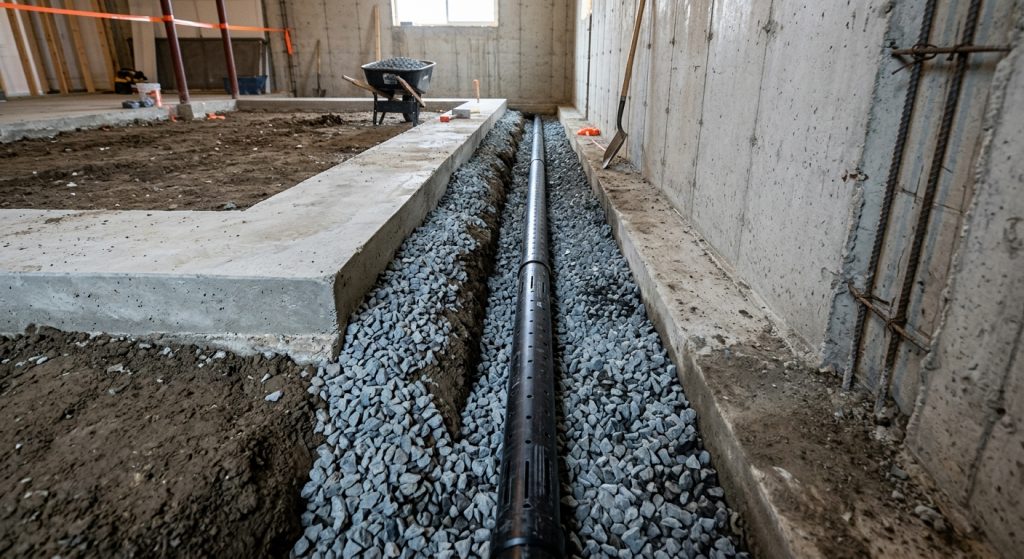
Interior drain tile (sometimes called a French drain or interior weeping tile) runs along the inside perimeter of the basement floor. Contractors break up the concrete, install the pipe system in gravel-filled trenches, and pour new concrete over it. This approach costs less than exterior excavation and doesn’t disturb the yard, but it doesn’t stop water from entering the wall itself. Instead, it captures water that has already penetrated and routes it to the sump pit before it can cause damage or mold.
For many Toronto homes, especially semi-detached properties or houses with tight lot lines, interior drain tile is the practical choice. It solves the flooding problem without requiring excavation that would affect neighboring properties or shared driveways.
How Long Do Drain Tile Systems Last?
This depends on the material. Modern perforated PVC and corrugated HDPE pipe can last 50 years or more under normal conditions. The original clay tile that was standard until the 1980s typically lasts 30 to 50 years before it begins to crack, collapse, or become clogged with roots and mineral deposits.
Toronto homes built before 1985 very likely have clay tile systems. If your house was built in the 1950s or 1960s and has never had the drainage system updated, you’re probably overdue for an inspection. The Greater Toronto Area has a high concentration of pre-1970 housing stock, which means this is a widespread issue rather than an edge case.
Soil conditions also matter. Heavy clay soil, which is common across much of the GTA, holds water longer and exerts more pressure on aging pipe. Tree roots are another major factor. Maples, willows, and cottonwoods send roots far and wide in search of moisture, and they’re very good at finding and colonizing any crack in an old drain tile joint.
Signs Your Drain Tile System Is Failing
You don’t need a plumber or engineer to recognize the early warning signs. Most failures announce themselves in predictable ways:
Water along the base of basement walls. If you see dampness, efflorescence (white mineral deposits), or actual water seeping at the joint between your basement floor and wall, that’s often a sign that the drain tile is overwhelmed or no longer functioning.
Puddles near the foundation outside. If your yard pools water for hours after a rain, particularly near the house, the exterior drainage isn’t moving water away properly.
Sump pump running constantly. A pump that runs every few minutes, even during dry weather, suggests it’s working overtime to compensate for a drainage system that isn’t handling the load.
Cracks in the foundation wall. Horizontal cracks or bowing can indicate sustained hydrostatic pressure that the drain tile should be relieving. This warrants immediate professional attention since it affects structural integrity.
Mold or musty odor. Chronic moisture at low levels can produce mold before you see visible water. A persistent musty smell in the basement, even with no obvious dampness, often traces back to a drainage issue.
Repair vs. Replace: Making the Right Call
A clogged exterior drain tile can sometimes be cleared by hydro-jetting. Root infiltration in a localized section can sometimes be addressed with targeted excavation and repair. If the system is relatively new (post-1990 plastic pipe) and the damage is limited to one section, repair makes sense.
If you have original clay tile, the calculus changes. Clay tile fails systemically: clearing one clog doesn’t fix the crumbling joints, root infiltration elsewhere, or the accumulated sediment throughout the system. Many contractors who clear a clay tile line find that the pipe collapses during cleaning because it’s already too compromised. Full replacement is often more cost-effective long-term than repeatedly patching an aging system.
A video inspection using a pipe camera can confirm the condition of your drain tile before you commit to any approach. This is a low-cost diagnostic that gives a clear picture of what’s actually happening underground.
Toronto Soil Conditions and Drain Tile Performance
Toronto sits on a mix of glacial till and lake sediment, with heavy clay content across much of the city, particularly in older neighborhoods like East York, Scarborough, and North York. Clay soil expands when wet and contracts when dry, which creates seasonal movement that puts mechanical stress on buried pipes and foundation walls over time.
The city’s annual precipitation pattern also works against aging drainage systems. Toronto averages around 780 mm of precipitation per year, with significant variation. Spring snowmelt combined with rain events can deliver large volumes of water over short periods. A drain tile system that barely manages normal conditions can fail catastrophically during a wet spring or after a major storm.
The City of Toronto offers a Basement Flooding Protection Subsidy Program that reimburses homeowners for eligible upgrades including sump pump installation and backwater valve installation. Drain tile replacement may qualify depending on scope and documentation. It’s worth checking eligibility before proceeding with major drainage work.
Frequently Asked Questions
Q: How much does drain tile replacement cost in Toronto?
A: Interior drain tile installation typically runs $8,000 to $15,000 for an average Toronto basement perimeter. Exterior replacement costs more, often $15,000 to $30,000 or higher, depending on excavation depth, lot access, and the need to restore landscaping or paving.
Q: Can I add a drain tile system if my basement has never had one?
A: Yes. Interior drain tile can be installed in basements that were originally built without it. It requires breaking up the concrete floor around the perimeter, installing the drainage pipe and sump pit, and restoring the concrete surface.
Q: Will a new drain tile system stop all basement moisture?
A: Drain tile handles hydrostatic pressure and groundwater intrusion effectively. It doesn’t address above-grade water entry through window wells, door thresholds, or through-wall penetrations. A full waterproofing assessment identifies which pathways need to be addressed.
Q: Is interior or exterior drain tile better?
A: Exterior drain tile is more comprehensive because it keeps water away from the foundation entirely. Interior drain tile is a practical alternative when exterior excavation isn’t feasible or cost-effective. Both approaches provide meaningful protection when properly installed.
Q: How do I know if my home has old clay tile?
A: Homes built before approximately 1985 in Toronto are likely candidates. A camera inspection of the drain line can confirm the material and condition without excavation.
Protect Your Basement Before the Next Rainy Season
Drain tile systems work quietly until they don’t. By the time a homeowner notices water in the basement, the system may have been underperforming for years. If your Toronto home is more than 40 years old and the drainage has never been inspected or updated, scheduling a camera inspection is a reasonable first step. IcyReno’s team serves Toronto, Etobicoke, North York, Scarborough, and East York. Contact us to discuss your drainage situation and get an honest assessment of what your home actually needs.

Written by
Sarah Keane
Sarah has spent years writing about home renovation projects across the GTA. She focuses on practical basement improvement topics that help Toronto homeowners protect and upgrade their biggest investment.