 Trusted Contractor Since


You did everything “right.” You noticed the smell of mildew, maybe saw a dark patch on the concrete, and you hired a contractor. You paid for waterproofing. Yet, here you are six months later, standing in your Toronto home, and the air still feels heavy. The cardboard boxes in the corner are soggy at the bottom.
It is incredibly frustrating. It feels like you threw money into a black hole.
In my years working with Icy Reno across the GTA, I’ve walked into hundreds of basements just like this. The homeowner is usually annoyed and confused, holding a warranty paper that feels useless. The truth is, your basement might be waterproofed partially, but water is relentless. It finds the weakness you didn’t know existed.
If your basement is still damp after being “fixed,” it’s usually because the solution treated the symptom, not the structural reality of your home. Here is what is actually happening beneath your feet and why the permanent fix might be something you haven’t considered yet: Basement Underpinning.
1. The “Wall vs. Floor” Trap (Hydrostatic Pressure)
Most standard waterproofing jobs focus entirely on the walls. Whether it’s exterior waterproofing (digging around the house) or interior waterproofing (installing a membrane inside), the goal is to stop water from punching through the foundation walls.
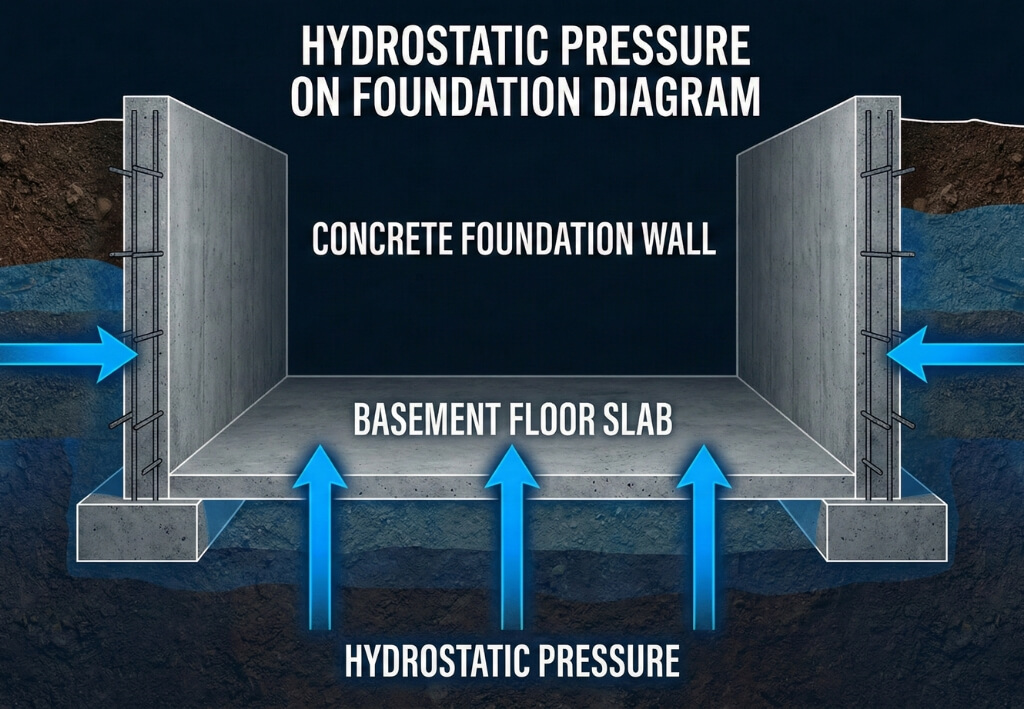
But here is the catch: water doesn’t just come from the sides. In Toronto, we deal with heavy clay soil that holds water like a sponge. When it rains or snow melts, the water table rises. This creates massive upward force called hydrostatic pressure.
If you waterproofed the walls but left the original, thin, cracked concrete floor slab, water will simply be pushed up through the floor. It evaporates into the air, causing that unshakeable damp feeling, or seeps in where the wall meets the floor (the cove joint).
The Expert Take: You can’t stop a rising water table with wall paint. You need a drainage system that goes under the floor.
2. Your “Waterproofing” Was Actually Just “Damp-Proofing”
There is a massive difference between these two terms, but they are often used interchangeably by less experienced contractors.
- Damp-proofing is usually a thin coating (like tar or a spray-on sealant) applied to the foundation. It stops soil moisture, but it cannot handle pressurized water or a flooded yard. It eventually becomes brittle and cracks.
- Waterproofing involves flexible membranes, weeping tiles, and drainage boards designed to redirect bulk water.
If your previous contractor just slapped a coat of sealant on the inside of your brick or block walls, they put a band-aid on a bullet hole. In older Toronto homes, the foundation blocks are porous. Water soaks into them. If you seal the inside, that water gets trapped in the wall, eventually rotting out the structural integrity of your foundation.
3. The Weeping Tile Disconnect
Every functional basement needs a weeping tile (a drainage pipe) to carry water away from the house.
In many older Toronto neighborhoods think The Annex, High Park, or East York the original weeping tiles are made of clay. Over 80+ years, these clay pipes collapse or get clogged with tree roots.
If you installed an interior waterproofing system but it wasn’t connected to a functioning sump pump or a clear drainage line, that water is being collected… and then just sitting there. Without a clear exit path (which often requires a backwater valve or sump pump), the water pools under your foundation, keeping the concrete perpetually wet.
4. The Structural Solution: Why Underpinning is the “Nuclear Option” for Dampness
This is where the conversation shifts from “patching leaks” to “upgrading your home.”
Sometimes, the dampness persists because the foundation itself is failing or simply too shallow to handle the modern environment. This is where Basement Underpinning becomes the hero.
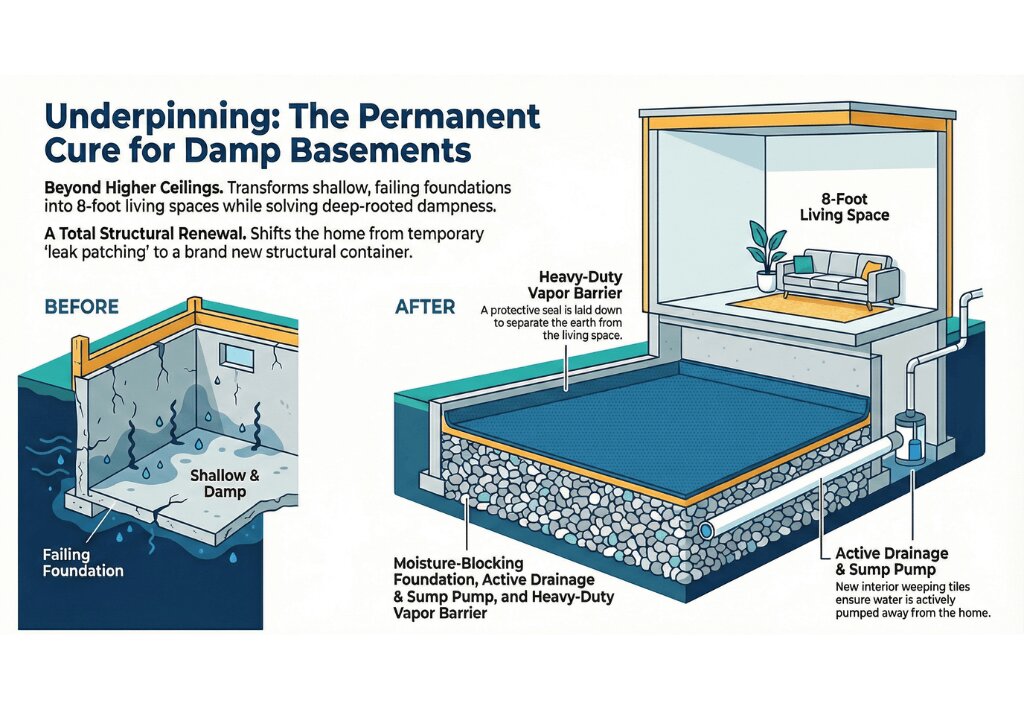
Most people think underpinning is just about lowering the floor to get higher ceilings. While that is a huge benefit (hello, 8-foot ceilings!), the process of underpinning actually solves the dampness problems that standard waterproofing can’t touch.
Here is why Underpinning fixes the dampness for good:
- New Foundation Floor: We remove the old, thin, cracked concrete floor completely.
- Proper Gravel Layer: We install a fresh layer of gravel, which breaks the capillary action (stopping water from wicking up).
- New Drainage: We install brand new interior weeping tiles and connect them to a sump pump, ensuring water is actively pumped away from your home.
- Vapor Barrier: A heavy-duty vapor barrier is laid down before the new concrete is poured, sealing the earth off from your living space completely.
When you hire professional underpinning contractors in Toronto, you aren’t just getting a deeper basement; you are getting a brand new, dry, structural container for your home.
5. The Toronto Factor: Why Our City is Different
We’ve seen it a thousand times. A homeowner buys a charming Victorian semi. They renovate the kitchen but ignore the basement. Two years later, the hardwood floors on the main level start cupping because of the humidity rising from below.
Toronto’s infrastructure is aging. The city experiences severe weather events that our older sewer systems simply weren’t designed to handle. In fact, the City of Toronto officially advises homeowners to take proactive measures like downspout disconnection and proper grading because the risk of basement flooding is a city-wide priority.
If you are relying on a 1920s foundation to keep out 2020s storms, you are fighting a losing battle. Sometimes, leak repair is enough. But if the dampness is persistent, it’s a sign that the house’s interface with the ground needs to be reset.
Is It Time to Dig Deeper?
If you are tired of running a dehumidifier 24/7 and still smellin g that musty odor, stop looking for “quick sealants.” You need to look at the structure.
At Icy Reno, we tackle the heavy lifting so you don’t have to. We’ve spent years mastering basement underpinning across Toronto because we know a truly dry home starts from the ground up. It’s not just about patching a leak it’s about giving your home a stronger, fresher foundation.
Don’t settle for “mostly dry.”
If you want to explore how lowering your basement can simultaneously add massive value to your home and solve your moisture issues forever, let’s talk.